

For Property and Casualty (P&C) insurance carriers, Managing General Agents (MGAs), and brokerages across the United States and Canada, operational continuity is not just a KPI—it is a regulatory and fiduciary requirement. From First Notice of Loss (FNOL) intake to underwriting support and claims endorsements, back-office capacity must be fast, secure, and reliable.
To scale operations and control loss ratios, many North American insurers delegate essential processing tasks to offshore talent hubs. However, a major offshore BPO risk often goes overlooked until catastrophic events occur: the extreme climate and geographical vulnerability of popular non-Indian outsourcing destinations.
When natural disasters paralyze these regions, the very back-office engines built to handle policyholders’ crises end up going offline—leaving US and Canadian insurers stranded during peak claims volumes.
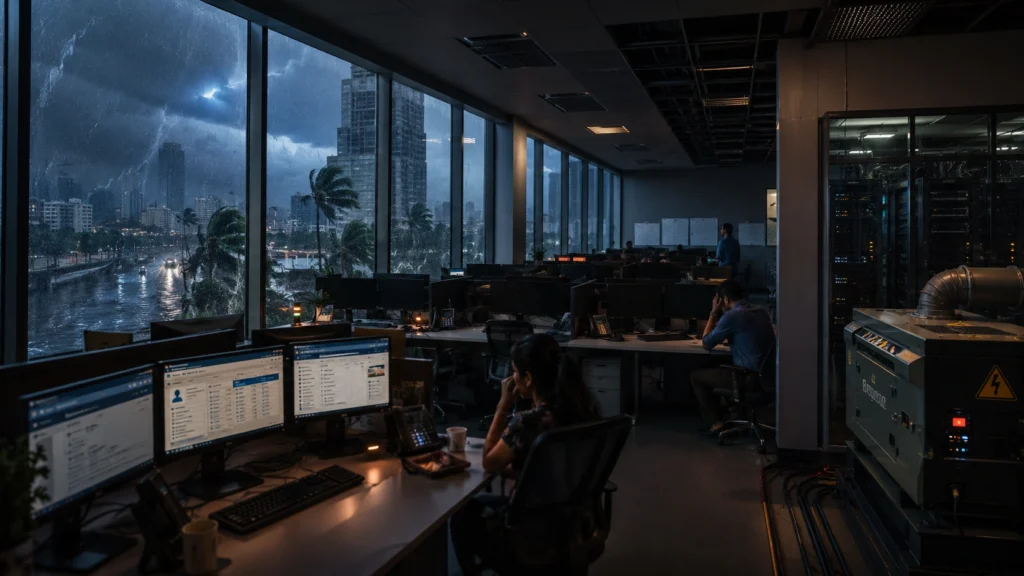
The Macro Picture: The Combined Toll of Disasters on Offshore Hubs
Extreme weather events across global outsourcing markets have escalated in both frequency and severity. According to global disaster tracking data and the Germanwatch Climate Risk Index:
- Over $4.5 Trillion in Economic Losses: Climate-related disasters (cyclones, monsoon floods, extreme heat, and landslides) caused over $4.5 trillion in direct global losses over recent decades, driven by nearly 10,000 extreme weather events.
- Severe Human Impact: Hundreds of thousands of fatalities and billions of affected citizens continually strain public infrastructure, energy grids, and communication networks across the Global South.
- Concentrated BPO Risk: Many prominent offshoring countries rank among the world’s most weather-vulnerable nations, suffering recurring structural damage that repeatedly takes business operations offline.
Country-by-Country: How Climate Volatility Disrupts Non-Indian Hubs
When evaluating your P&C supply chain, looking at individual offshore destinations reveals recurring operational vulnerabilities:
| Country | Primary Disaster Risks | Impact on Outsourced Operations |
| The Philippines | 20+ Typhoons/year, Earthquakes (27,500+ deaths; $35B+ losses) | Fiber line cuts, multi-day grid blackouts in Manila/Cebu BPO hubs |
| Colombia | Landslides, Flash Floods ($490M+ expected annual loss) | Urban transit collapse, forced unvetted remote work transitions |
| Pakistan | Record Monsoon Floods (1,700+ deaths; $30B+ in 2022) | Long-term power grid instability, severe telecom downtime |
| Bangladesh | Cyclones, Mass Inundation (100M+ people recurringly hit) | Frequent subsea cable outages, facility closures in Dhaka |
| South Africa | Extreme Drought, Torrential Flooding (e.g., KZN floods $2B+) | Municipal infrastructure strain, severe load-shedding disruptions |
1. The Philippines
- The Vulnerability: Positioned in the Pacific typhoon belt, the Philippines endures roughly 20 typhoons per year. Historical data records over 27,500 deaths and more than $35 billion in direct losses from extreme weather events.
- P&C Impact: Super-typhoons regularly sever subsea fiber-optic cables and destroy regional power grids. During severe storms, Manila and Cebu-based BPO operations face prolonged blackouts, leaving North American carriers without crucial FNOL intake and claims support during domestic weather surges.
2. Colombia
- The Vulnerability: Mountainous topography makes Colombia highly susceptible to recurring landslides and flash flooding, with expected annual disaster losses exceeding $490 million.
- P&C Impact: Landslides routinely block transit corridors and damage municipal infrastructure in tech hubs like Medellín and Bogotá. When staff cannot reach secure delivery centers, unvetted work-from-home setups create elevated data security risks for sensitive policyholder Personally Identifiable Information (PII).
3. Pakistan
- The Vulnerability: The devastating floods of 2022 affected over 33 million people, killed more than 1,700, and caused over $30 billion in damage and economic losses.
- P&C Impact: Severe flooding destabilizes national telecom networks and regional power grids for extended periods, crippling back-office processing for underwriting documents, billing, and loss checks.
4. Bangladesh
- The Vulnerability: Low-lying geography subjects Bangladesh to severe monsoon flooding and tropical cyclones that routinely inundate major cities and affect tens of millions of people.
- P&C Impact: Frequent internet disruptions and urban flooding disrupt policy administration schedules and slow down critical claims intake operations.
5. South Africa
- The Vulnerability: Plagued by extreme weather shifts—ranging from severe multi-year droughts to catastrophic flash floods (such as the KwaZulu-Natal floods causing over $2 billion in damage)—compounded by national energy grid vulnerabilities (load-shedding).
- P&C Impact: Simultaneous weather events and power rationing create unpredictable operational outages that compromise strict processing Service Level Agreements (SLAs).
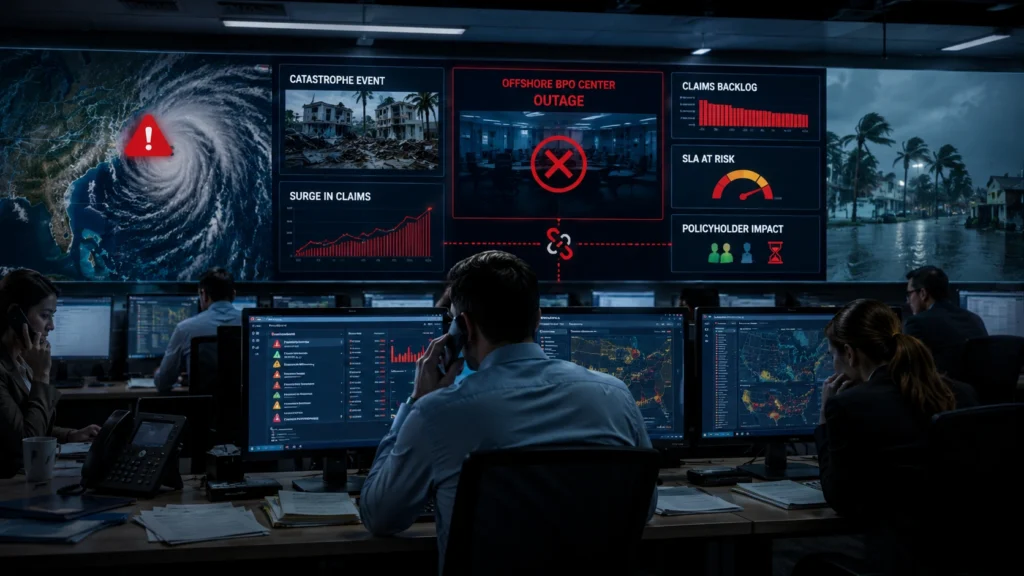
What Disaster-Driven Outages Cost P&C Insurers
When a North American winter storm or hurricane triggers a spike in claims, your back-office support must be at peak capacity. If your offshore vendor goes dark due to a cyclone in their region, the operational fallout is immediate:
The P&C Disaster Bottleneck: A domestic catastrophe strikes North America \rightarrow FNOL and claims volumes surge 300\% \rightarrow Offshore vendor loses power due to local weather \rightarrow Backlog explodes, SLAs fail, and policyholder satisfaction plummets.
- Catastrophic Backlogs: Claims age rapidly, leading to delayed payouts, higher litigation rates, and increased loss adjustment expenses (LAE).
- Underwriting Delays: Quotes, renewals, and binders stall, forcing agencies and brokers to write business with faster-moving competitors.
- Compliance Breaches: Emergency workarounds during disasters often bypass data protection protocols mandated by state insurance departments and OSFI/NAIC guidelines.
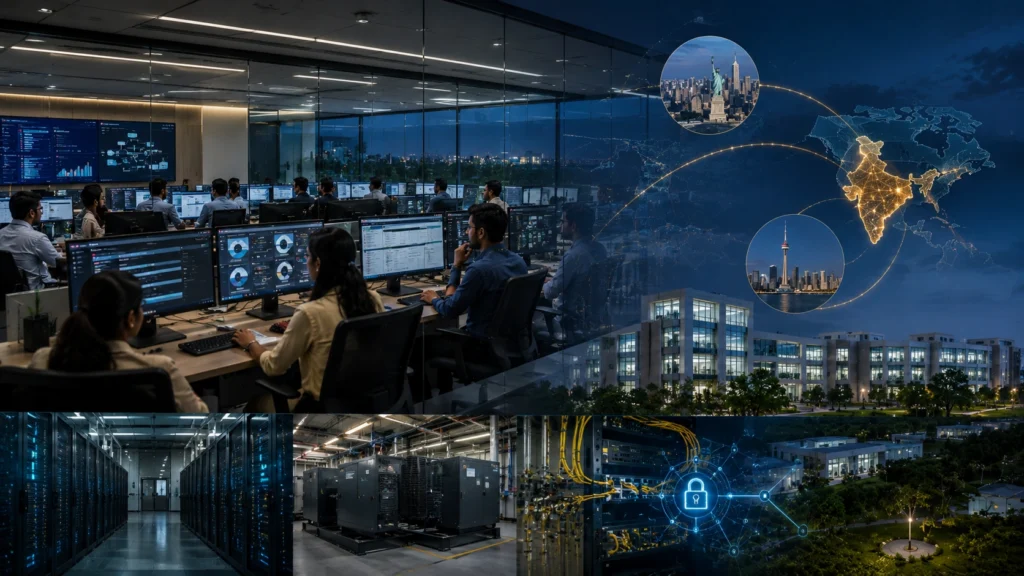
The Indian Advantage: Unmatched Geographic Stability & Scale
To eliminate climate risk from your operational chain, smart P&C leadership routes back-office processing to India—the world’s most resilient destination for financial services execution.
INDIA’S P&C RESILIENCE MODEL
| Geographic Safety | Technical Redundancy |
| Major hubs (Bengaluru, NCR, Hyderabad, Pune) located inland. | Tier-4 data centers with dual-grid power & multi-provider fiber. |
| Exempt from typhoons & major seismic risk zones. | Distributed cross-city backup BCP system. |
- Geographically Safe Tech Hubs: Unlike island nations or low-lying deltas, India’s premier BPO and technology corridors (Bengaluru, Hyderabad, Pune, and the National Capital Region) are inland and geologically stable. They are unaffected by typhoons, major oceanic surges, or high-seismic threats.
- Enterprise-Grade Infrastructure: India’s tier-1 technology parks operate on dual-grid power feeds, heavy-duty industrial backup generators, and redundant subsea cable landings.
- Specialized P&C Domain Expertise: India possesses the world’s largest pool of insurance-trained back-office specialists experienced in US and Canadian policy systems (e.g., Guidewire, Duck Creek, Applied Epic).

Secure Your P&C Operations with Agency Boost
Risk management is the heart of Property and Casualty insurance. Your back-office operational setup should embody those same risk-mitigation principles.
Agency Boost provides US and Canadian P&C carriers, MGAs, and agencies with back-office and technology execution anchored in India’s most secure and scalable delivery hubs.
Why Partner with Agency Boost?
- Zero-Downtime Continuity: Built on resilient Indian infrastructure, our operations run uninterrupted—ensuring your FNOL, policy processing, and loss control management stay online during critical weather spikes.
- Strict SLA Guarantees: Enjoy fast turnaround times for endorsement processing, quote generation, and policy renewals to give your business a competitive edge.
- Enterprise Security & Compliance: Full alignment with NAIC, OSFI, and state/provincial privacy regulations to protect PII and insurance records under robust SOC-compliant security protocols.
Protect Your Bottom Line from the Unexpected
Unpredictable weather in an offshore vendor’s country shouldn’t disrupt your ability to serve policyholders when they need you most. Upgrade your back-office execution to India with Agency Boost and secure operational stability, domain expertise, and complete peace of mind.